You're Getting 9s in Your GCSE Practice Papers. So Why Did You Blank in the Mock?
You've been revising for weeks. Practice quizzes: 90%. Flashcard recall: consistent. Your teacher thinks you're on track for a 9. Then the mock arrives. Real conditions. No phone. No AI. No second chances. And suddenly, questions you've answered dozens of times feel unfamiliar. You hesitate. You change your mind. You hand in a paper that doesn't reflect what you know — or what you thought you knew. This happens to thousands of UK students every year. And it's not a revision problem. It's a confidence problem — one that traditional revision tools are completely blind to. StartSprint is the first revision platform built to reveal it.
The Dirty Secret of Revision Scores
Here's something most students — and many teachers — don't know: getting a question right in revision tells you almost nothing about whether you'll get it right in an exam. What matters isn't just the answer. It's how you got there. Did you know it immediately, with confidence? Or did you read the options three times, eliminate two, cross your fingers, and land on the right answer by educated guess? Both routes produce the same result in a traditional revision tool. But in a real exam — under pressure, with no process of elimination, in a time-limited, high-stakes environment — those two routes produce very different outcomes. The student who knew it confidently will answer it again. The student who guessed it will blank. This is the confidence gap — the space between what your score says and what you actually know — and closing it is the single most important thing you can do before your GCSEs or A-Levels.
How StartSprint Reveals Your Confidence Gap
StartSprint doesn't just mark your revision quizzes right or wrong. It watches how you answer — and builds a Behavioural Confidence Score (BCS) for every topic you revise. The BCS is powered by three signals: Hesitation Time, Answer Switching, and Confidence Pattern. Hesitation Time tracks how long you pause before clicking an answer. A topic you truly know produces fast, confident responses. A shaky topic results in hesitation, even if you eventually get it right. StartSprint logs this to the millisecond, across every question.
Understanding Answer Switching
Answer Switching indicates whether you changed your answer, and from what to what. Switching from correct to incorrect is the most telling signal of all. It means your first instinct was right, but you talked yourself out of it. That's not a knowledge problem — it's a confidence problem — and it has a very specific fix. Together, these signals build a picture of your true confidence level on every topic — independent of whether you got the question right. A high score with a low BCS means you're at risk in the real exam, while a moderate score with a high BCS means you're more prepared than your score suggests.
What Your Revision Dashboard Actually Shows You
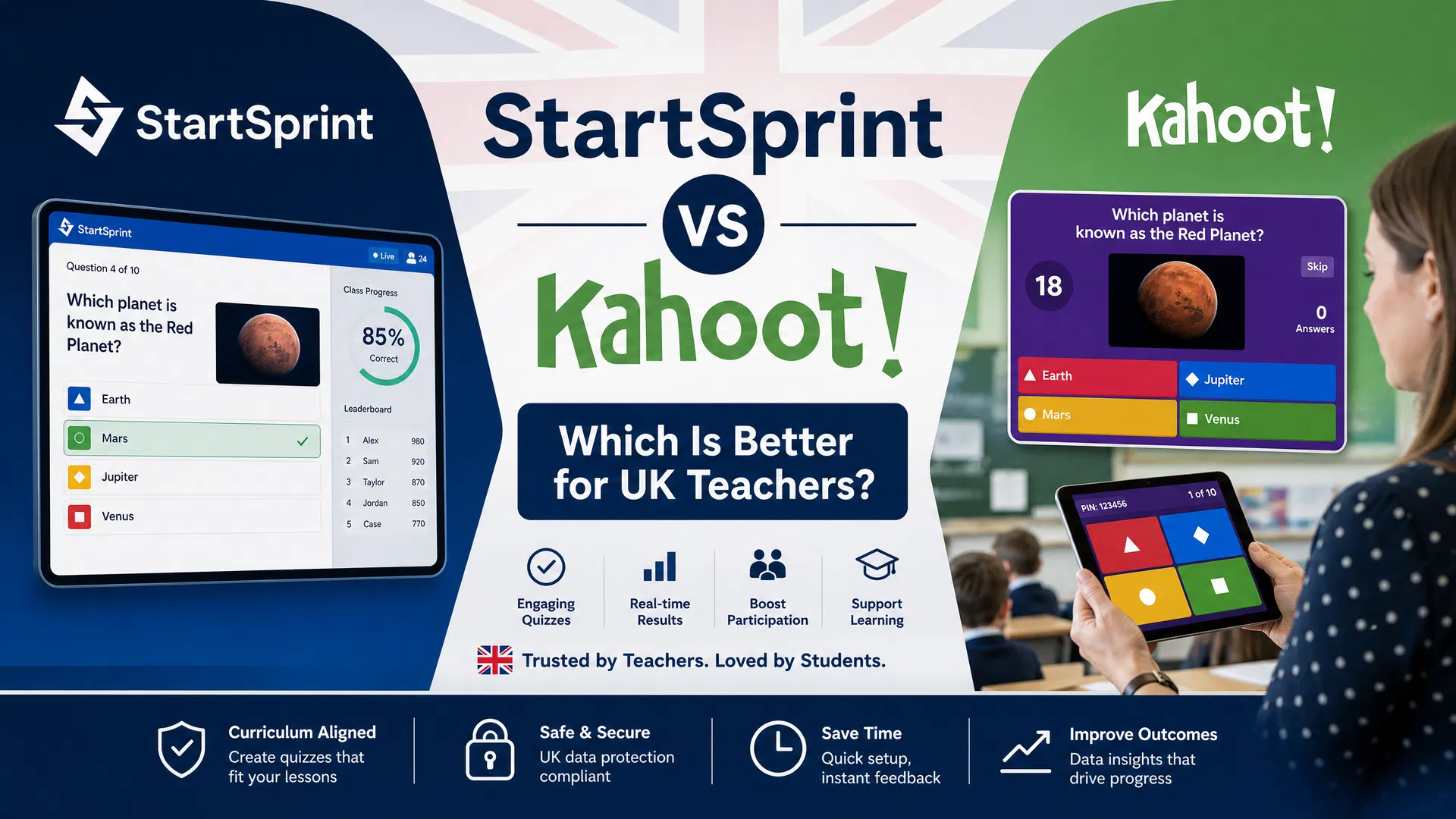
After any revision session on StartSprint, you'll see a dashboard that illustrates your performance. For example: Topic: Photosynthesis, Quiz Score: 9/10, Behavioural Confidence Score: 88%, Status: ✅ Confident — exam ready. Cell Division might show 8/10 with a BCS of 44%, labelled as ⚠️ Shaky — revise again. In contrast, DNA & Genetics could present a perfect score of 10/10 but a BCS of only 21%, indicating a 🔴 Guessing — do not skip status. This data is crucial; it reveals how well you truly understand the material.
The AI Problem — And Why Your Behaviour Can't Lie
Let's talk about the elephant in the revision room. AI tools can answer almost any GCSE or A-Level question in seconds. If you're using AI to check your revision answers — or worse, to complete your quizzes for you — your scores look perfect. Your teacher thinks you're fine. But here's what AI can't do: sit your exam for you. StartSprint detects the confidence gap that appears when a student is using AI or memorising answers without genuine understanding. The hesitation, the switching, and the absence of true confidence behind the correct answers all indicate a lack of readiness.
How to Actually Use StartSprint in Your Revision
StartSprint works best when you use it the way it's designed — as a truth-teller alongside your normal revision. Step 1: Revise normally — use your notes, textbooks, past papers, whatever works. Step 2: Take a StartSprint quiz on the topic you've just revised — without notes, under mild time pressure. Step 3: Check your BCS, not just your score. Topics with a BCS above 75% are solid. Topics between 40–75% need another pass. Topics below 40% need a full rethink — even if the score looks fine. Step 4: Target your weak BCS topics — not your low-scoring topics. This approach takes the guesswork out of revision prioritisation.
Free for Students, Available Right Now
StartSprint is free for individual students. You can sign up at www.startsprint.app and start a revision session in under 5 minutes. You'll need your school to be using StartSprint for the full teacher-linked BCS features. If your school isn't on it yet, you can still use the platform independently — and you can ask your teacher about it. A growing number of UK schools are rolling it out specifically because their students asked for it.
Key Takeaway
Your revision score is a starting point. Your Behavioural Confidence Score is the truth. In 2026, with AI making it easier than ever to get the right answer without understanding why, the gap between revision performance and exam performance has never been wider. StartSprint closes that gap. It shows you exactly which topics you truly know and which ones you might be overestimating. It provides a data-driven revision strategy, giving you confidence in your abilities.
Start revising smarter at www.startsprint.app. Your future success in exams depends on understanding where you truly stand.