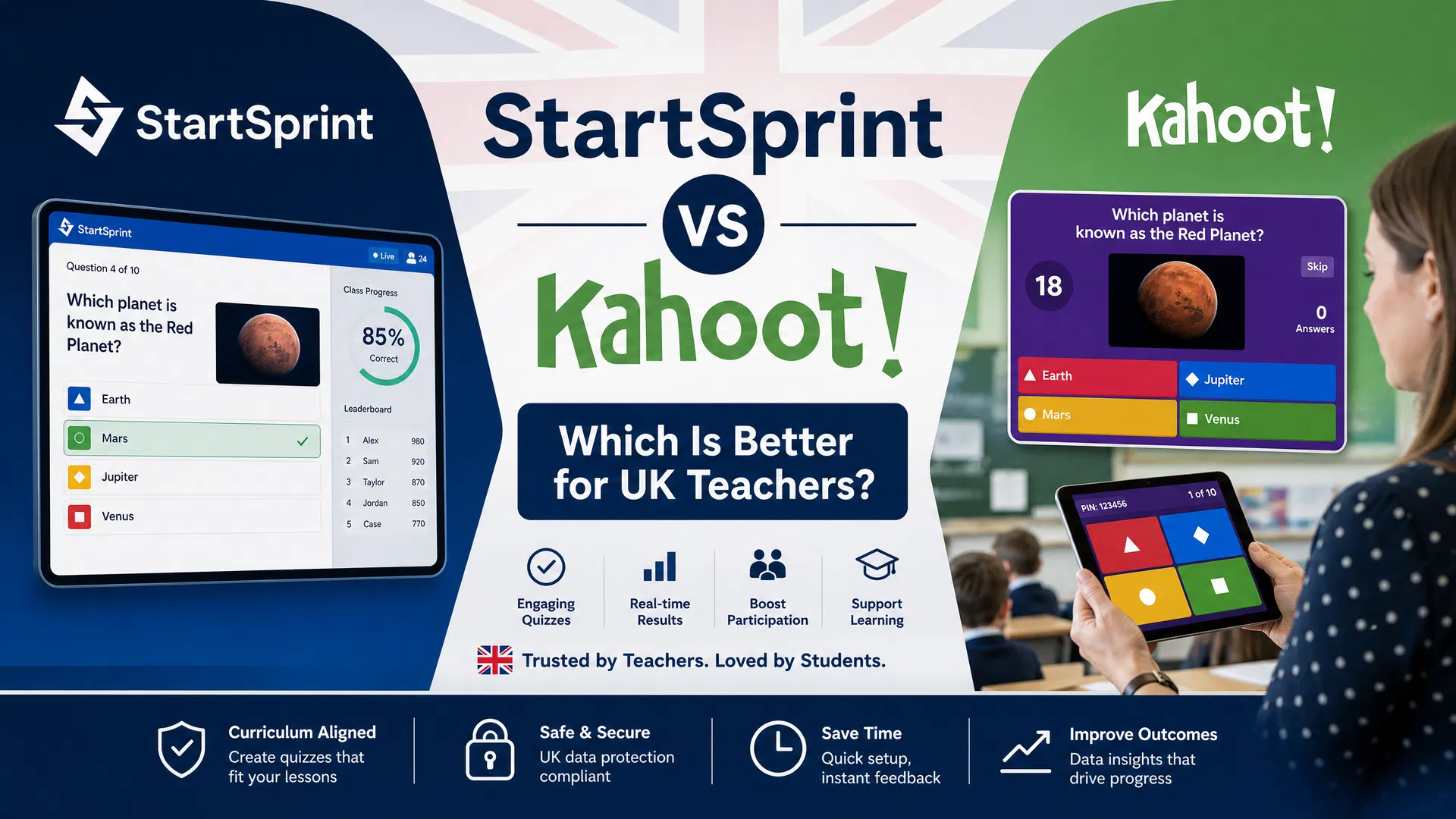
StartSprint vs Kahoot: A Comparative Overview
When it comes to classroom engagement tools, two names dominate the conversation: Kahoot and StartSprint. Both platforms promise to transform how teachers deliver quizzes and engage students, yet they represent fundamentally different philosophies about what makes learning effective.
Kahoot has built a massive following through gamification and entertainment. Students compete on leaderboards, celebrate wins with confetti animations, and experience the rush of competition. It's fun, engaging, and millions of students worldwide use it daily. But here's the question every UK teacher should ask: Does entertainment equal learning?
In contrast, StartSprint approaches classroom engagement with a focus on understanding. It uses behavioral intelligence to analyze not just whether students get answers right, but how they arrive at those answers. This distinction is crucial for effective teaching, as it enables educators to identify gaps in knowledge and misconceptions.
The Kahoot Advantage: Engagement and Accessibility
Kahoot’s strength lies in its simplicity and universal appeal. Teachers can create a quiz in minutes, launch it in class, and watch students immediately engage. The competitive element—leaderboards, real-time scoring, and celebratory animations—taps into intrinsic motivation. Students want to win, so they pay attention and try hard.
For many educators, this is exactly what they need. In a classroom where student engagement is the primary challenge, Kahoot delivers results. Students who might otherwise be disinterested suddenly care about the quiz, leading to skyrocketing participation rates. Additionally, Kahoot’s freemium model makes it accessible to every teacher, transforming quiz technology for schools with limited budgets.
The StartSprint Difference: Behavioural Intelligence
StartSprint’s advantage lies in what happens after the quiz. While Kahoot shows a final score, StartSprint provides in-depth insights into student performance. For instance, if a student scores 75% on a quiz, StartSprint reveals not only the score but also which questions the student struggled with, whether they were guessing, and what misconceptions they might hold.
This behavioural intelligence transforms quiz data from a simple score into actionable insights that drive instruction. Teachers can see how performance compares to learning patterns and receive personalized recommendations for intervention, allowing for tailored support that is vital for student success.
Feature Comparison: A Head-to-Head Analysis
When comparing the features of Kahoot and StartSprint, both platforms have their unique strengths. Kahoot excels in setup time, requiring only 2-3 minutes to create a quiz, while StartSprint may take slightly longer at 3-5 minutes. Kahoot is known for extensive gamification, including leaderboards and animations, while StartSprint focuses more on learning outcomes.
Kahoot provides basic student engagement metrics, while StartSprint offers advanced insights into confidence, attention, and persistence. Furthermore, StartSprint is aligned with the UK curriculum, ensuring that quizzes meet national educational standards, making it a strong choice for UK teachers.
When to Use Kahoot vs StartSprint
Kahoot is ideal for ice-breakers and energisers, creating a fun atmosphere to capture students’ attention. It works well for formative assessments when you want to check surface-level knowledge quickly. Additionally, it is highly effective in large group settings, where its simplicity can engage many students simultaneously.
On the other hand, StartSprint is more suited for diagnostic assessments. When you need to understand why students are struggling, StartSprint’s insights help identify misconceptions effectively. It also excels in providing personalised instruction by adapting to individual learning needs, thereby supporting tailored educational approaches.
The Verdict: A Strategic Approach
Ultimately, the best approach isn’t to choose between Kahoot and StartSprint, but to use them strategically. Employ Kahoot when you need engagement and energy in the classroom, while utilising StartSprint for insights and understanding. Many UK teachers already implement this dual strategy, using Kahoot for fun quizzes and StartSprint for more serious assessments.
If you had to choose one, the decision depends on your teaching philosophy. If you believe that engagement is the foundation of learning, Kahoot may be your platform of choice. However, if you prioritise understanding, StartSprint could be the better fit.
Key Takeaway
In conclusion, both Kahoot and StartSprint have their merits in enhancing classroom engagement. Kahoot excels in creating a lively, competitive environment, while StartSprint provides invaluable insights into student learning patterns. For UK teachers striving to achieve a deeper understanding of their students, StartSprint’s behavioural intelligence can make a significant difference.
Consider your classroom needs and the learning outcomes you aim to achieve. By integrating both platforms where appropriate, you can create a dynamic learning environment that fosters both engagement and lasting understanding.