Can Your Students Really Prove They Know It? The UK's Assessment Crisis
Here's a scenario every UK teacher recognises. A student submits a quiz, scoring 9 out of 10, appearing confident and consistent. However, in the next lesson, when asked to explain the same concept, they respond with a blank stare. This isn't a case of laziness or a bad day; it's the failure of traditional assessment tools to differentiate between genuine knowledge and mere guessing.
As we move into 2026, with AI accessible to every student and Ofsted scrutinising schools on their ability to provide evidence of genuine learning progress, the disparity between what a score indicates and what a student truly understands has never been more critical. StartSprint was developed to bridge this gap.
Why Traditional Quiz Platforms Aren't Enough Anymore
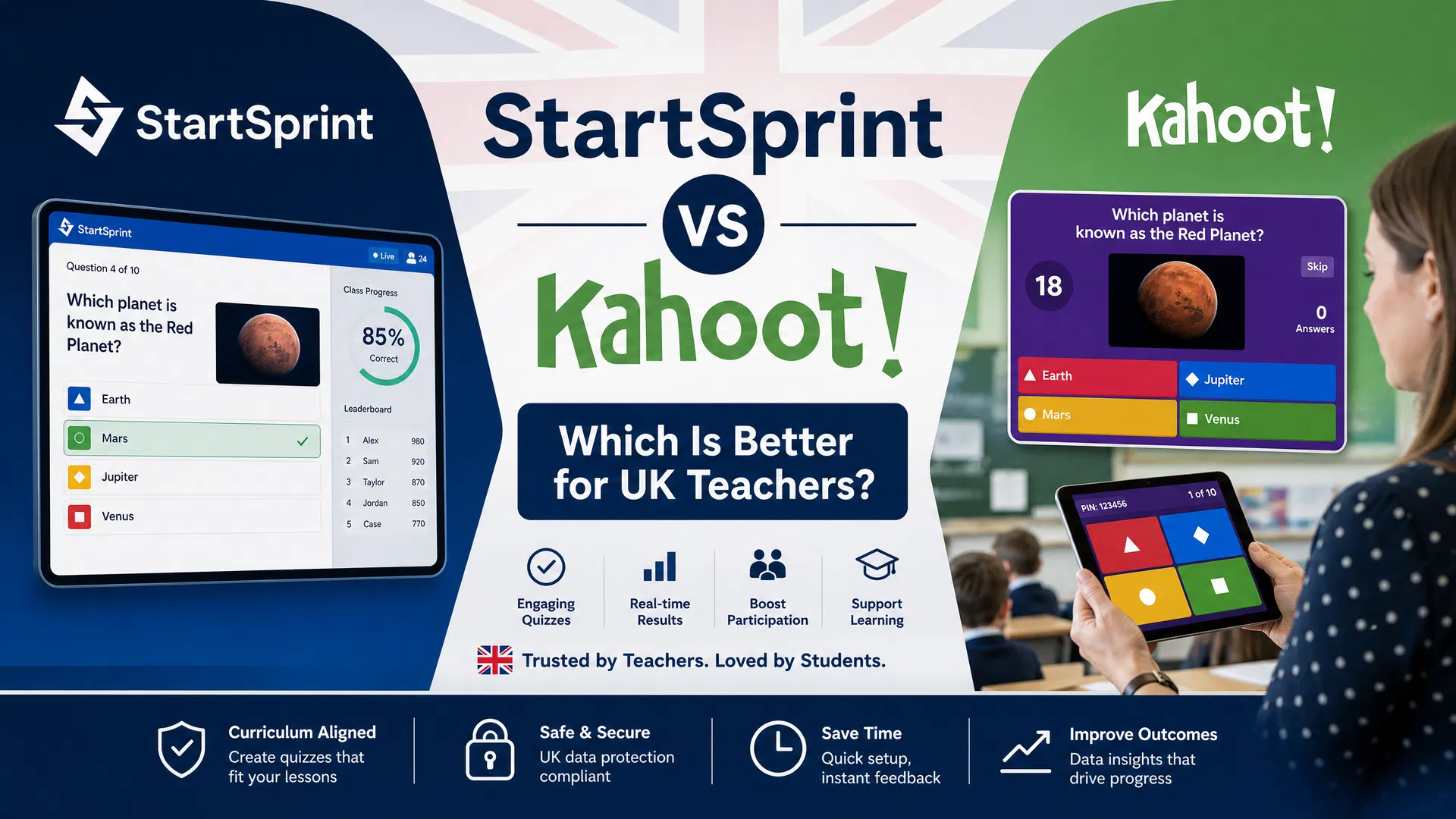
Platforms like Kahoot, Quizlet, and Quizizz have their merits as engaging tools that enhance student participation and generate scores. However, they fundamentally fall short in revealing the underlying reasons behind those scores. A student who achieves 8 out of 10 through genuine understanding appears identical to one who achieved the same score through guessing or even assistance from AI.
While traditional platforms effectively capture the output of learning, StartSprint focuses on the process itself. In an educational landscape increasingly influenced by AI and scrutiny from Ofsted, understanding this process is paramount.
AI Has Made the Problem Much Worse
The current reality in UK classrooms is that students have access to AI tools capable of providing answers faster than any human could. With a simple screenshot of a question, a student can receive the correct answer and an explanation in mere seconds. This has resulted in students achieving higher scores than ever, while their actual comprehension diminishes.
For teachers, this presents a daunting challenge. Relying solely on scores fails to provide insight into whether a student has genuinely engaged with the material or has outsourced their learning to AI. With exam season approaching and Ofsted's increased focus on quality learning evidence, the inability to discern genuine understanding can have severe implications.
What Behavioural Assessment Actually Measures
StartSprint captures behavioural signals during a quiz, which, though invisible to the student, are incredibly revealing for teachers. These signals include hesitation time, which measures how long a student pauses before selecting an answer.
A student who understands their material tends to respond swiftly and confidently, while a guesser may hesitate or change their answers. StartSprint logs these hesitations to the millisecond across every question and attempt.
Another key measure is answer switching. Did the student change their answer, and in which direction? Shifting from a wrong to a correct answer indicates a positive confidence signal, while switching from correct to wrong suggests second-guessing. Combined, these metrics form a Behavioural Confidence Score (BCS), an actionable number that complements traditional scoring.
What Teachers Actually See
Consider a teacher's StartSprint dashboard post-quiz on Quadratic Equations. For example, Chloe may score 9/10 with an 87% BCS, indicating confidence. In contrast, Sarah may score a perfect 10/10 but with a BCS of only 22%, suggesting she guessed her way through.
Without StartSprint, Sarah would be mislabelled as a top performer, potentially leading to her struggles in a GCSE mock exam where the same questions are presented without AI assistance. This scenario is being observed daily by StartSprint's 100+ active teachers across the UK.
How StartSprint Aligns with Ofsted's 2026 Framework
The Department for Education's latest EdTech guidance necessitates schools to move beyond mere score recording and towards evidencing true learning progress. Ofsted is actively inspecting schools on these grounds. StartSprint's dashboard generates reports that are Ofsted-ready and demonstrate which students are progressing with authentic understanding versus those who are merely memorising.
This data enables school leaders to pinpoint comprehension gaps across classes and evaluate the effectiveness of interventions. In the 2026 inspection landscape, the ability to furnish such evidence is increasingly crucial for achieving a Good or Outstanding rating.
Real Numbers from Real Classrooms
Since its launch in March 2026, StartSprint has made significant strides. Over 2.4 million assessment interactions have been captured, with 100 teachers actively using the platform daily, all before any charges were implemented.
Currently, four schools are utilising the platform on a daily basis, and three Department Heads have initiated discussions about rolling it out school-wide. Notably, Northampton College has adopted StartSprint as part of its daily routine.
How to Get Started
StartSprint is available free of charge for individual teachers, allowing you to set up in under ten minutes. Simply sign up at www.startsprint.app, create your first quiz or import existing questions, and share them with your class.
As students engage with the quizzes, you will receive Behavioural Confidence Scores that provide a clearer understanding of their true knowledge levels. For Heads of Department, department licences start from £499/year, while school licences begin at £1,200/year for comprehensive solutions and Ofsted-ready reporting.
Key Takeaway
The time for traditional assessment methods is over. In an age dominated by AI and increasing scrutiny from Ofsted, behavioural assessment is not just a luxury but a necessity for educational success. StartSprint offers the first platform designed to provide teachers with the insights they need.
By embracing behavioural assessment, you can gain a deeper understanding of your students' true capabilities, ensuring that they are genuinely prepared for the challenges ahead. Start free today at www.startsprint.app.