Understanding Student Misconceptions
One of the most challenging aspects of teaching is understanding what students truly know versus what they merely appear to know. A student might score 85% on a quiz, but what does that score really tell you about their understanding? Without deeper analysis, you might miss critical misconceptions that could undermine their future learning.
This is where assessment data analysis becomes invaluable. By examining not just the final answers but the patterns within student responses, teachers can identify misconceptions early and intervene before they become entrenched. This article explores how to use assessment data to uncover student misconceptions and improve learning outcomes.
What Are Student Misconceptions?
Student misconceptions are incorrect understandings or false beliefs about concepts, often deeply rooted and resistant to change. Unlike simple mistakes or careless errors, misconceptions represent systematic misunderstandings that persist across multiple problems and contexts. A student might consistently apply a wrong formula, misunderstand a fundamental principle, or hold a false belief about how something works.
For example, many students hold the misconception that multiplication always makes numbers larger. This works for whole numbers but breaks down when multiplying by fractions. Without identifying this misconception, students will struggle with fraction multiplication for years.
Why Traditional Assessment Misses Misconceptions
Traditional assessment methods—multiple-choice tests, short-answer quizzes, standardized tests—measure what students get right or wrong but provide limited insight into why they get answers wrong. A student who answers incorrectly might be guessing, might have a systematic misconception, or might simply have made a careless error. The test score alone cannot distinguish between these scenarios.
This limitation has significant consequences. Teachers might assume a student understands a concept when they've simply gotten lucky with their guesses. Conversely, teachers might assume a student doesn't understand when they've made a single careless error. Without accurate diagnosis, interventions are often ineffective or misdirected.
How Behavioral Intelligence Reveals Misconceptions
Behavioral intelligence analyzes how students respond to questions, not just what answers they give. By examining response patterns, timing, and consistency, behavioral intelligence can distinguish between genuine understanding, lucky guesses, and systematic misconceptions.
Response Pattern Analysis
When a student consistently chooses the same wrong answer across multiple questions, it suggests a systematic misconception rather than random guessing. For instance, if a student consistently chooses the distractor that represents a common algebraic error, this reveals the specific misconception they hold.
Timing Signals
How quickly a student answers can provide insight into their confidence and understanding. A student who answers quickly and correctly likely understands the concept, while a student who answers quickly but incorrectly might be guessing. Conversely, a student who takes a long time before answering incorrectly might be struggling with the concept.
Consistency Across Contexts
True understanding transfers across different contexts and problem types. If a student can solve a problem in one context but not in another, this suggests incomplete understanding or a context-specific misconception.
Confidence Signals
Some assessment platforms allow students to indicate their confidence in their answers. Low confidence combined with correct answers suggests guessing, while high confidence combined with incorrect answers suggests a misconception.
Practical Steps to Identify Misconceptions
To effectively identify misconceptions, teachers should follow a structured approach. First, analyse wrong answer patterns by reviewing quiz results beyond simply counting right and wrong answers. Examine which questions students got wrong and what wrong answers they chose. If multiple students choose the same incorrect option, this is a strong signal of a common misconception.
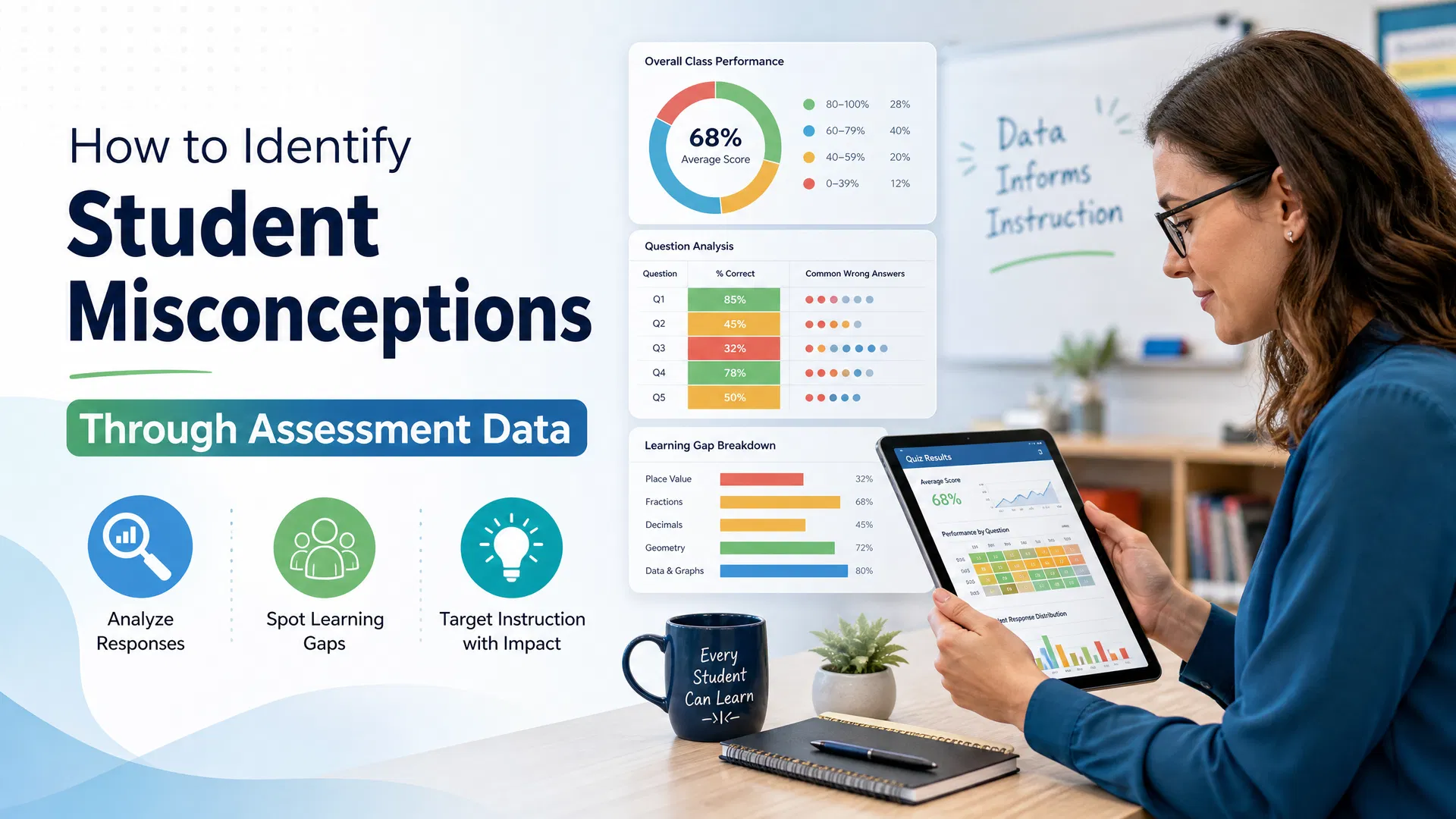
Create a simple analysis table showing each question, the correct answer, and the distribution of student responses. This visual representation often reveals patterns that aren't obvious from individual scores.
Next, look for consistency in responses. Examine whether students who get one question wrong also get related questions wrong. If a student misses all fraction problems but gets whole number problems correct, this suggests a specific misconception about fractions.
Additionally, interview students about their thinking. After identifying potential misconceptions, engage students in conversation about their reasoning. Ask them to explain how they solved a problem or why they chose a particular answer. Their explanation will often reveal the misconception clearly.
Moreover, use diagnostic assessments to confirm suspected misconceptions. Create problems that would be answered correctly if the student understands but incorrectly if they hold the suspected misconception.
Finally, track misconceptions over time to monitor whether interventions are working and whether the misconception persists or reappears in new contexts. Keeping records of which misconceptions each student holds can significantly enhance teaching strategies.
Common Misconceptions by Subject
Misconceptions vary across subjects. In mathematics, students often believe that multiplication always makes numbers larger or that division always makes numbers smaller. They may also misunderstand negative numbers and the concept of fractions, holding the belief that fractions are always less than whole numbers.
In science, common misconceptions include the idea that heavier objects fall faster or that heat and temperature are the same thing. Moreover, some students believe that plants get their mass from soil or that seasons are caused by distance from the sun.
In English and Language Arts, students may think longer sentences are always better, or that adjectives always come before nouns. Additionally, they might believe that the theme of a story is always stated explicitly.
Intervention Strategies for Common Misconceptions
Once you've identified a misconception, intervention should be targeted and explicit. Simply re-teaching the correct concept often isn't enough; students need to understand why their misconception is wrong. One effective strategy is to present problems where the misconception leads to an obviously wrong answer.
For example, if students think multiplication always makes numbers larger, ask them to predict the answer to 0.5 × 10, then calculate it. The conflict between their prediction and the actual result creates cognitive dissonance that motivates learning.
Explicit correction is also crucial. Directly address the misconception by explaining what it is, why it’s wrong, and what the correct understanding is. This approach is usually more effective than simply presenting the correct information.
Using multiple representations can enhance understanding. Present concepts using different formats—visual, verbal, symbolic, and concrete. This approach helps students build a more robust understanding that is less vulnerable to misconceptions.
Contextualised practice is also important. Have students apply the correct concept in various contexts to help them understand that the concept is broadly applicable, not just a special case.
Using Technology to Scale Misconception Detection
Manually analysing assessment data for misconceptions is time-consuming. Educational technology platforms like StartSprint can automate this process, analysing thousands of student responses to identify patterns and flag potential misconceptions.
These platforms can automatically identify common wrong answer patterns, flag students who might hold specific misconceptions, recommend targeted interventions, track misconception remediation over time, and generate reports for teachers and administrators.
This automation allows teachers to focus on what they do best: designing interventions and working with students to build correct understanding.
Key Takeaway
Identifying student misconceptions is one of the most impactful things teachers can do to improve learning outcomes. By moving beyond simple right/wrong scoring to analyse response patterns, teachers can diagnose misconceptions accurately and intervene effectively.
Behavioural intelligence makes this process faster and more accurate, allowing teachers to help every student build solid conceptual understanding. The result is students who don't just get the right answers but truly understand the concepts behind them.