Every teacher in the UK knows the feeling.
You've just finished a lesson on quadratic equations. You set a quick quiz. The results come back — 78% correct. You breathe a sigh of relief. The class got it.
Then the exam happens. And half of them fail.
What went wrong?
The answer is one of the most uncomfortable truths in education: a  right answer is not the same as understanding.
The Problem with Traditional Assessment
UK schools have spent decades measuring learning through a single metric: the score.
A student answers correctly. The system records a pass. The teacher moves on.
But what the score doesn't capture — what it fundamentally cannot capture — is the journey behind that answer. Did the student know it instantly? Did they hesitate for 12 seconds, change their answer twice, and get lucky? Did they use ChatGPT the moment your back was turned?
Traditional assessment tools — Google Forms, Kahoot, even most dedicated quiz platforms — all share the same architectural flaw: they were built to collect answers, not to understand learners.
This is where behavioural intelligence changes everything.
What Is Behavioural Intelligence in Education?
Behavioural intelligence is the discipline of capturing how a student interacts with an assessment — not just what they answer.
The signals that matter most are invisible to traditional tools:
Hesitation time. How long did a student pause before selecting an answer? A student who answers correctly in 0.4 seconds has a fundamentally different understanding from one who deliberates for 18 seconds before clicking the right option.
Answer switching. Did the student change from a correct answer to an incorrect one — or the reverse? Answer switching is one of the strongest predictors of whether learning is secure or fragile.
Speed-accuracy patterns. Fast correct answers indicate strong retrieval. Slow correct answers may indicate guessing, AI assistance, or surface-level recall without deep understanding.
Confidence consistency. A student who is consistently fast and accurate is different from one who is inconsistent — fast on some questions, slow on others. Inconsistency is a red flag that deserves teacher attention.
Together, these signals build a Behavioural Confidence Score for every student, on every question, in every session.
Why This Matters Right Now for UK Teachers
The UK education system is facing a perfect storm that makes behavioural intelligence not a luxury — but a necessity.
The AI cheating crisis. Students can now access AI-generated answers in seconds. A correct score on a quiz proves nothing about whether the student understood the content. Teachers need a new signal. Behavioural intelligence provides it.
Ofsted's evidence requirements. UK EdTech guidance now requires schools to demonstrate genuine learning progress — not just recorded scores. A Behavioural Confidence Score is exactly the kind of evidence that satisfies that requirement.
The hidden gap problem. Students who consistently guess correctly advance through the curriculum without mastery. These gaps compound silently until they become catastrophic results at GCSE or A-Level. Behavioural intelligence surfaces these students before the crisis point.
SEND identification. Students with SEND often display distinctive response-time patterns that differ from neurotypical learners. Behavioural intelligence can flag these patterns — prompting teachers to investigate, support, and escalate where appropriate.
How StartSprint Captures Behavioural Intelligence
StartSprint is the UK's first assessment platform built specifically around behavioural intelligence.
When a student takes a quiz on StartSprint:
1. The platform captures hesitation time to the millisecond — logging exactly how long a student spent on each answer option before submitting.
2. Answer switches are recorded — direction, frequency, and timing of each change are stored.
3. A Behavioural Confidence Score is calculated — combining hesitation, accuracy, speed, and switching patterns into a single interpretable metric per student per question.
4. The teacher receives actionable decisions — not a dashboard of raw numbers, but clear prompts: "Reteach this topic tomorrow — 60% of the class showed guessing behaviour." Or: "Marcus T. has been flagged as At-Risk for 3 consecutive weeks. Consider escalating to your SENCO."
Critically, the student sees nothing different. The assessment experience is identical to any other quiz. The intelligence is captured entirely in the background.
Practical Applications for UK Classroom Teachers
Here's how behavioural intelligence changes the daily workflow for a typical UK secondary school teacher:
Before class: Review the Behavioural Confidence Scores from last lesson's exit quiz. Identify which students showed low confidence — and adjust your starter activity to address their specific gaps.
During class: Set a live StartSprint quiz. Watch as real-time flags appear for students showing hesitation patterns or answer switching — allowing you to intervene during the lesson, not after.
After class: The Decision Engine generates a lesson report automatically. It tells you which topics to reteach, which students to monitor, and which students are ready to advance. No manual marking. No guesswork.
For parents' evening: Show parents not just their child's score, but their child's confidence trajectory over the past term. It's the most meaningful educational conversation most parents have ever had.
What the Research Says
The link between response time and learning quality is well-established in educational psychology. Research by the Education Endowment Foundation consistently shows that formative assessment — when done well — is one of the highest-impact, lowest-cost interventions available to UK schools.
The problem has never been that formative assessment doesn't work. The problem is that existing tools don't capture enough signal to make it truly effective.
Behavioural intelligence is the missing layer.
The Competitive Landscape: What Everyone Else Is Missing
To understand why behavioural intelligence matters, it helps to look at what the leading alternatives offer:
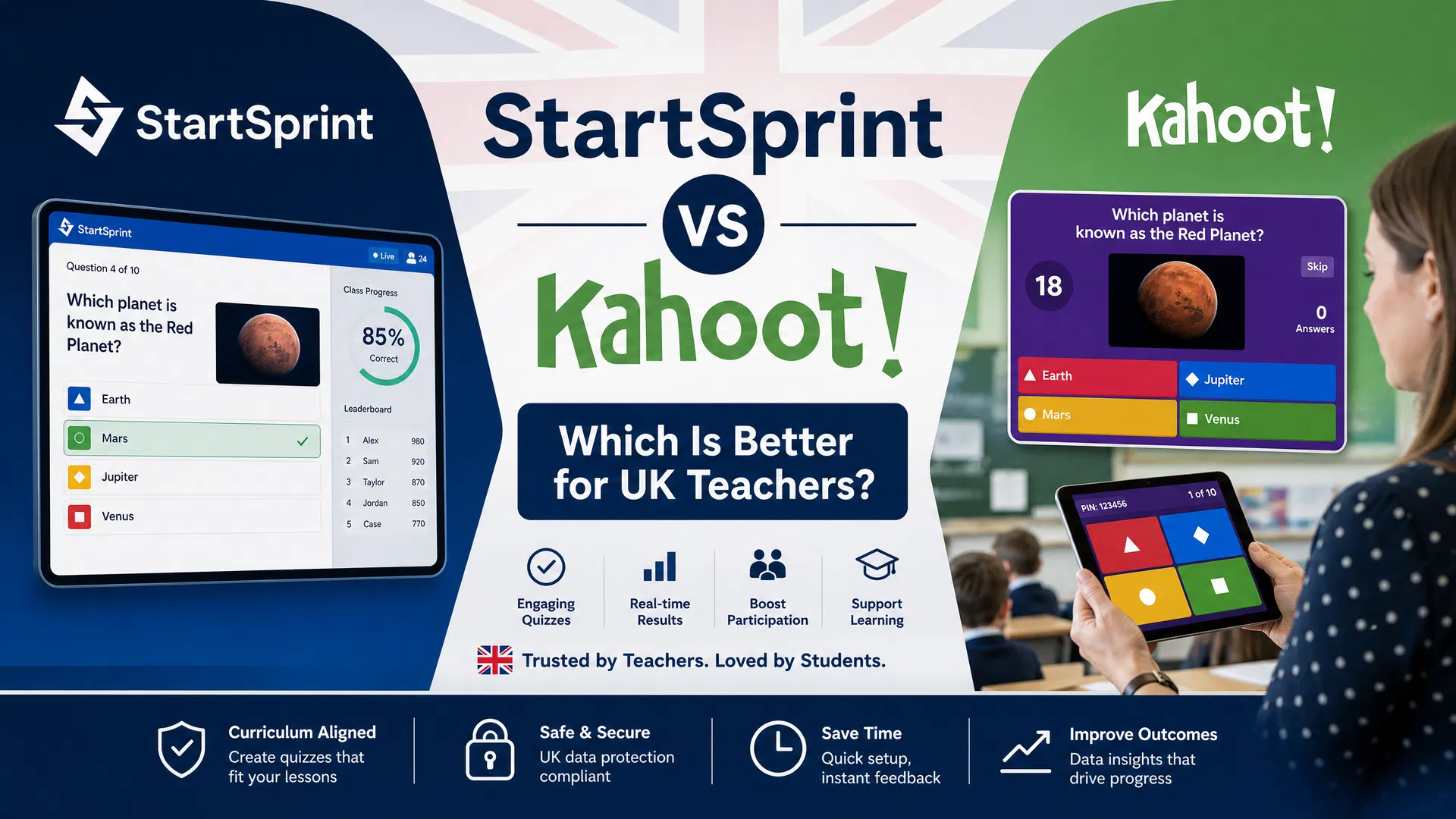
Kahoot captures engagement. It tells you how quickly students answered and whether they had fun. It does not tell you whether they understood.
Quizlet stores knowledge. It helps students practise. It does not tell teachers whether that practice is producing genuine mastery.
Google Forms collects responses. It tells you what percentage got each question right. It tells you nothing about the journey behind those responses.
CENTURY Tech identifies knowledge gaps and recommends next steps. It is closer to the intelligence layer — but it focuses on what students know, not on how they think under assessment conditions.
StartSprint is the only platform that sits specifically at the intersection of assessment and behavioural science. It doesn't replace lesson delivery tools — it adds the intelligence layer that every other tool is missing.
Getting Started: Free for UK Teachers
StartSprint is currently free for all UK teachers as part of the Educator Fellow programme.
You can set up your first quiz in under 5 minutes. The behavioural intelligence is captured automatically from your first session — no configuration, no data science required.
As you build up data across sessions, the Decision Engine becomes progressively more accurate — learning the baseline patterns for each of your students and surfacing deviations that deserve your attention.
The quiz is just the beginning.